This post contains promotional/affiliate links.
If you’ve ever watched a J.League match clip and wondered why an entire stand is chanting an Italian phrase for ninety minutes straight, this is the article for that. Japanese football chant culture looks chaotic from the outside, but it’s highly organized — and some of the melodies come from further away than you’d expect.
- Why the chanting is organized rather than spontaneous
- The difference between a team chant and a player chant
- Where some of the melodies actually come from — a Scottish pop hit, an Italian football tradition, a European dance track
- A few real chants with English translations
- Where to hear one for yourself
This is based on first-hand experience attending J.League matches and researching the club-by-club chant catalog we maintain elsewhere on this site — where a translation is uncertain or club-specific, we’ve said so rather than guessed.
Team Chants vs. Player Chants
Two different things are happening in the stands at once. Team chants are sung throughout the match regardless of who has the ball — they’re the club’s identity in song form, and they don’t change from week to week. Player chants are shorter, individual songs tied to a specific player, usually sung when that player is on the ball, warming up, or has just scored.
Both are led by official supporter groups stationed in the general admission end, with drums setting the tempo. The songs are rehearsed and specific to each club, which is why an entire section can stay in sync for ninety minutes without a conductor — and why, as we cover in our guide to watching a J.League match as a tourist, you’ll pick up the rhythm even on your first visit without knowing a word of Japanese.
Where the Melodies Actually Come From
A lot of J.League chants aren’t original compositions — they’re Japanese lyrics set to a borrowed melody, a tradition that goes back to English and Italian terrace culture. A few examples that turn up in our chant research:
Sanfrecce Hiroshima — “Hiroshima Night”
Set to the tune of “Saturday Night” by the Bay City Rollers, the Scottish pop group’s 1975 hit. The Japanese lyrics have nothing to do with the original song — they’re a straightforward call to run, fight, and take pride in the club’s home city.
Sanfrecce Hiroshima & Kyoto Sanga — “Forza Viola”
“Forza” (“come on”) is a staple of Italian football chanting, and “viola” means purple — the shared kit color of both clubs. Sanfrecce Hiroshima and Kyoto Sanga each have their own chant built around the same Italian phrase, independently of each other, simply because both clubs play in purple.
Vissel Kobe — “Facci un Gol”
Sung as-is in Italian — “score us a goal.” No translation into Japanese at all; the phrase itself has become the chant.
Urawa Reds — The Goalkeeper’s Chant
The chant for Urawa Reds goalkeeper Shusaku Nishikawa is set to “Carnaval De Paris,” a 1998 dance track by the group Dario G — a melody with no connection to Japan, France, or football, repurposed entirely for the terraces.
| Club | Chant | Melody source | What it means |
| Sanfrecce Hiroshima | Hiroshima Night | Bay City Rollers – “Saturday Night” | “Let’s go, anywhere – run, run! Shine, our pride – Hiroshima, Hiroshima.” |
| Sanfrecce Hiroshima | Forza Viola Ale’ | Italian football chant tradition | “Men of Hiroshima, purple stars – come with us! Forza Viola, allez!” |
| Vissel Kobe | Facci un Gol | Italian phrase, sung as-is | “Kobe, score us a goal!” |
| Urawa Reds | Nishikawa chant (goalkeeper) | Dario G – “Carnaval De Paris” | The goalkeeper’s name carried on the “allez” melody |
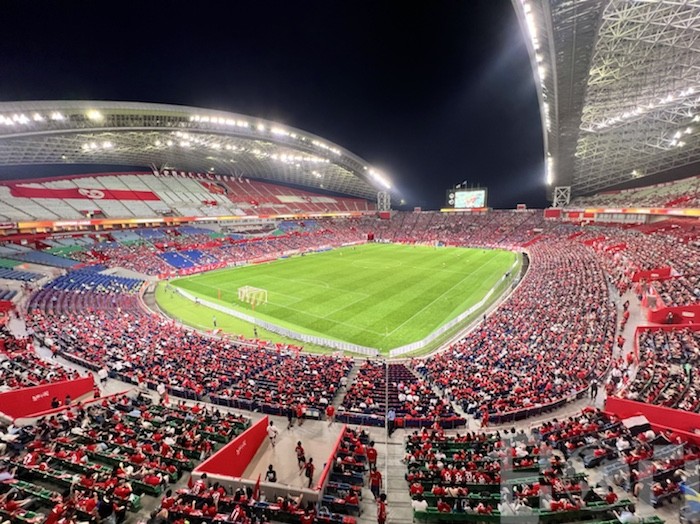
Hear It: Sanfrecce Hiroshima at Edion Peace Wing
The clip below is captioned in English and romaji, so you can follow along even without Japanese. “Hiroshima Night” opens the chant medley; “Forza Viola Ale’” comes in later, around the 30-minute mark.
Why This Matters If You’re Planning to Go
None of this is required knowledge for attending a match — you’ll pick up the rhythm in the stadium regardless. But knowing that the chant you’re hearing is secretly a 1975 Scottish pop song, or that two unrelated clubs share an Italian rallying cry because they both wear purple, tends to make the ninety minutes more interesting rather than less.
If this has you thinking about seeing one in person, we’ve put together guides to buying J.League tickets and what to expect at your first match, including the seat categories that put you closest to the supporter end where all of this is happening.
Summary
- Team chants run all match; player chants are shorter and tied to one person
- Many chants are Japanese lyrics set to borrowed foreign melodies — Scottish pop, Italian football tradition, European dance tracks
- Two clubs sharing a kit color can independently share a chant phrase, as Sanfrecce Hiroshima and Kyoto Sanga do with “Forza Viola”